


Kitesurfing with (too) much pressure in the kite? A 10 square meter kite with 40 knots wind. It's possible and can even be fun. Of course, we cannot recommend it, but it can also happen. It usually comes as a surprise and then you are overwhelmed with overpowering and probably overwhelmed.
With these precious tips you are going to master the situation 'massively overpowered on the kite' a little better.
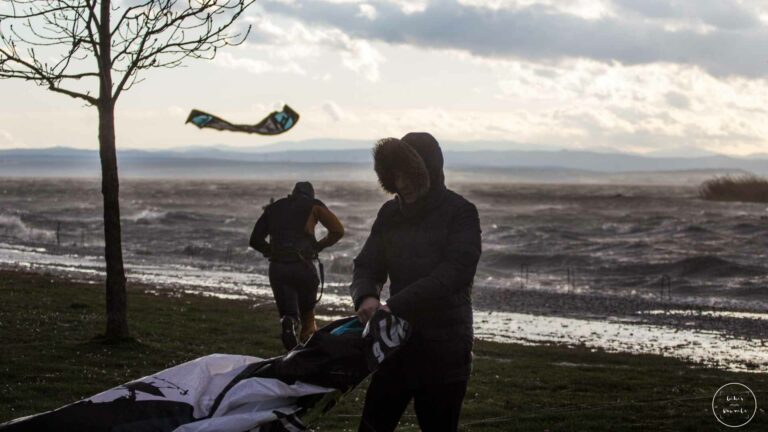
Before my last kite session I failed to check the wind forecast. Actually, I wanted to go to the office that day to do some work. But sunshine and massive wind at the lake changed my plan. So a short time later I was massively overpowered on the Duotone Rebel in 10sqm. And: it was a good thing! Because I had not had such a brilliant session with unbelievable heights at the lake for a long time.
Why was it still good? Because I had everything under control at all times, despite strong gusts with peaks around 40 knots.
How to stay in control and what you should pay attention to in this particular situation can be read in the following article. Please consider: this article is not an invitation to try yourself in the "overpower range". It still is about self-assessment and brainpower.
Overpowered when launching - 'Listen, stay calm'
Staying calm as an instruction is of course easy to say, but helpful for many situations. How do you keep calm? I think that you should always deal with certain (emergency) situations in advance and play through them in your head. Especially in the case of surprisingly strong winds (e.g. violent gusts), quick but calm decisions are important. You could feel any errors pretty quickly.
On shore or when launching, it quickly becomes uncomfortable when the situation gets out of control. I have seen many kiters hang overwhelmed onto their kite when the wind had picked up or the kite was too big. And 99% of people react in the wrong way.
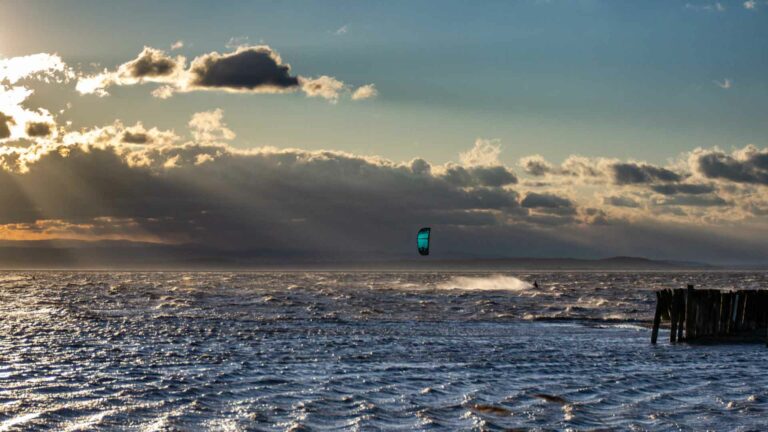
Tipps für den sicheren Kite-Start
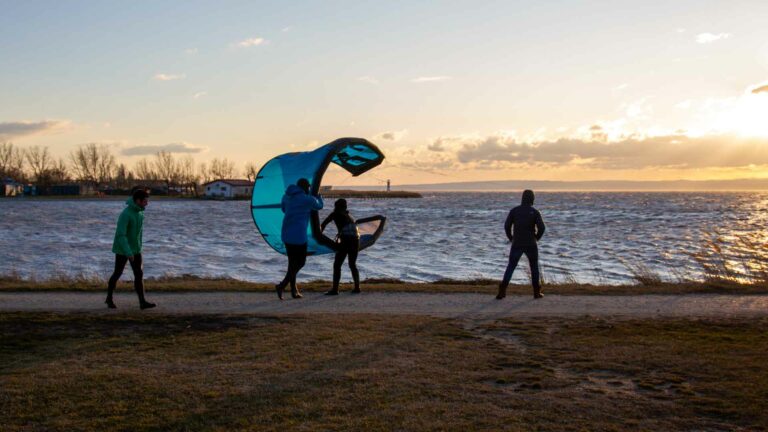
- Especially important at the lake: turn around in strong winds before starting the kite. You can see violent gusts on the water surface . There are definitely bad situations to show your thumbs up.
- Check your quick release again and remind yourself before launching that you have one.
- If you are rather insecure, let other kiters secure you on the harness. It's not embarrassing, it's just preventative. If you have a choice, get a trusted person who is knowledgeable about kiting. The person who secures you must also know when a kite starts to pull.
- DO NOT pull the adjuster all the way (fully depowered). A kite that is completely depowered just reacts sh*** to steering impulses and you hardly get any feedback at the bar. If the kite is too big, a pulled adjuster won't do any miracles.
- Do NOT steer the kite at 12 o'clock (this does not only apply if there is too much pressure in the kite). When the gust hits you and you pull a little at the bar, it goes up. Strangely, it doesn't feel as good on land and especially when it's uncontrolled. In addition, you can hardly go back with too much pressure in the kite, because it always pulls you up and you are tiptoeing around. So keep the kite on the edge of the wind window . Worst case, it pulls you away, at least only sideways and not upwards. Feels much better, believe me.
- Steer the bar carefully with feeling, grab it in the middle and avoid strong steering impulses. In the overpower range we do not need the kite to move quickly with a lot of speed. The wind is high speed already, so the kite can stay calm. And 'Oida!' (as an expression of anger), never take hold! No way! No way! on the lines to steer.
- Stay calm, relax, and don't force anything. If it is too much, it's too much. Just land your kite again and it's fine.
- If momentum gets going, you've definitely lost. By momentum I mean: if you run because the kite's pull becomes too violent, the rules of the game change and it is going to be unfair. My recommendation: quick release - but quickly. Only a few kiters come to a safe stop again. And until then, a hell of a lot can happen.
'Please, just sit down!'
At first I only wanted to briefly touch on the topic, but then the topic “sit down” has become a bigger one. Sitting down on the beach can avoid many bad situations. Why?
Sit down! It sounds strange, but it is not. You will not be able to walk while seated, and that is good, as we know by now. More importantly, you cannot stumble . Because if you stumble, the following happens: when stumbling, people usually have a natural reaction. A hand snatches off the bar by reflex and tries to cushion the fall, a natural thing. (And yes, it's always just one hand that wanders off the bar). Because the other hand does what people do when they fall: they try to hold on somewhere to save them. Got it? This is the moment when you hear other kiters screaming in vain on the beach: "Release, Releeeeeeeeaaaaase...!" Because: There is the momentum again. Holding on to the bar with one hand most likely leads to a pretty bad steering impulse, a steering impulse produces speed for the kite which we don't need on the beach in strong winds.
And if you continue to spin the thought, you often stumble forward and land on your belly. And where is the quick release located? Mhm, a lot of time goes by which you don't have in this situation. So you can actually spare yourself the 'Release' scream. The person on the kite already feels that something is wrong. But just can't think of the quick release or operate it. So stumbling is not recommended and usually leads to other emergency situations. So remember: Just sit down. Please.
Überraschender Starkwind am Wasser
In my opinion there are two possibilities on the water. Stay outside and wait or try to get to the beach and land. When I think of the sessions with us at the lake (with onshore wind), I usually think it makes more sense to stay on the water than to expose myself to the danger on onshore.
Of course, the following applies: situations are always a little different and you always have to assess the dangerous situation for yourself anyway. If you decide to stay on the water to sit out the situation (because violent gusts often don't last long), the following tips are suitable.
Tipps zum Kiten bei Starkwind am Wasser
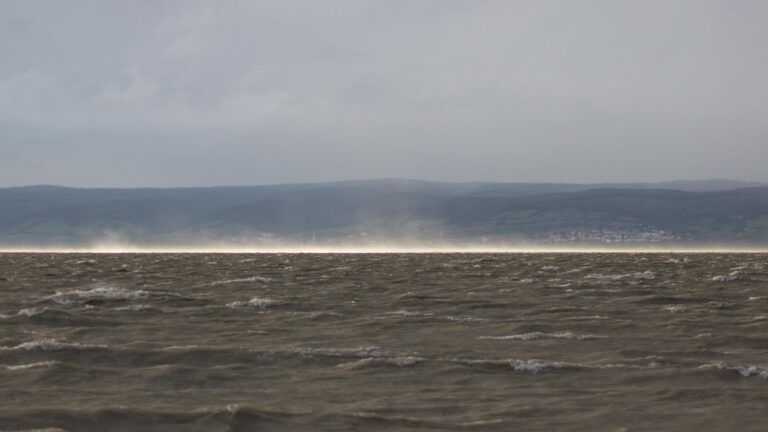
- As on land, keep turning around. You usually see something like this coming. It is ugly when water starts to fly. 'Spray' (see picture below) is often recognizable as a 'white wall'. If you see something like this, it becomes rather uncomfortable relatively soon.
- Buckle the straps on the board, i.e. the binding, as tight as possible. You can't afford to lose your board.
- Keep away from all possible sources of danger. Meaning other kiters and trees, stones etc.
- Fly the kite rather low (close to the water). Then there is 'only' lateral pull, and you can put the edge of the board into the water. If you steer the kite up, or even at 12 o'clock you will always lose the edge because you get lifted out of the water. But we have to stay on the water.
- Edge, edge and edge again. Now you create pressure with your board and go at walking pace. And no, do not lose the edge. Again, we don't want any additional speed here, either.
- Also consider (depends on the respective spot, of course), on which side of the wind window you position your kite. It would not be advisable to be dragged 'outside'. In an emergency, you have to come back to the beach by yourself (possibly even without a kite).
- Push the bar and remember again: slow, calm steering impulses. On the water you pull the adjuster more. Because: We stay and wait, hardly need any feedback at the bar and will definitely not have to fly sinusoids.
- If you lose your board it is going to get exhausting. Now it's your turn to body drag. And this can be really troublesome when totally overpowered. Because without a board you hardly have anything to push against the drag. Again: hold kite low so that your are not lifted out of the water and aim at long distances. Because when changing direction you have to fly the kite over 12 o'clock to the other side of the wind window. You will probably lose height (therefore collect meters towards luv at first).
- If none of this helps, you feel uncomfortable and maybe overwhelmed, use your quick release and let the kite hang on the safety. Whether you work your way towards the kite or not has to be decided in the respective situation. And no: it's not embarrassing .. You shouldn't be afraid of your security system.
- Only bring the board to other kiters if you are really sure what you are doing. It doesn't help if one person in need becomes two people in need. You should also be very careful when going towards a released kite.
'Prepare for Landing' - the dangerous situation
Landing can be extremely dangerous. I think in such a wind, where the majority of kiters on the water are actually overpowered, there is a certain hectic and nervous mood on the beach. Nothing necessarily negative, because that is how the senses are sharpened. Sometimes this stress and the hustle and bustle leads to weird decisions (especially for landing assistants). It is only over when your kite is firmly gripped in the hands of another person, the line tension is gone and you are unhooked. To get to this situation, I recommend the following:
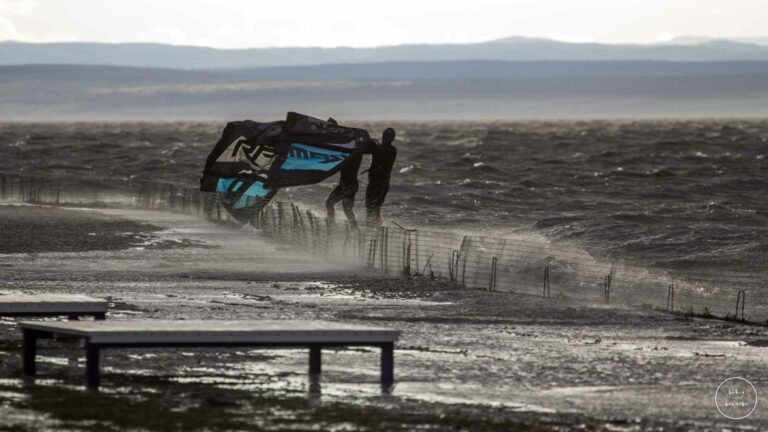
Tipps für das Landen deines Kites bei starkem Wind
- If you have the option, make sure everyone has the space they need to land kites. And make eye contact with people on the beach beforehand and let them know that you want to land.
- In most cases, when the wind is strong (except in offshore conditions), you travel with the wind (downwind course). Consequently, it feels like you don't have that much pressure in the kite. You will feel the pressure in the kite when you come to a stop. So keep a little distance from the beach when stopping . You may not even have to walk on the beach and can land while still in the water.
- Think about certain signs in advance so that you let people on the beach understand that they should secure you by grabbing your harness. Experienced kiters do things like that automatically anyway.
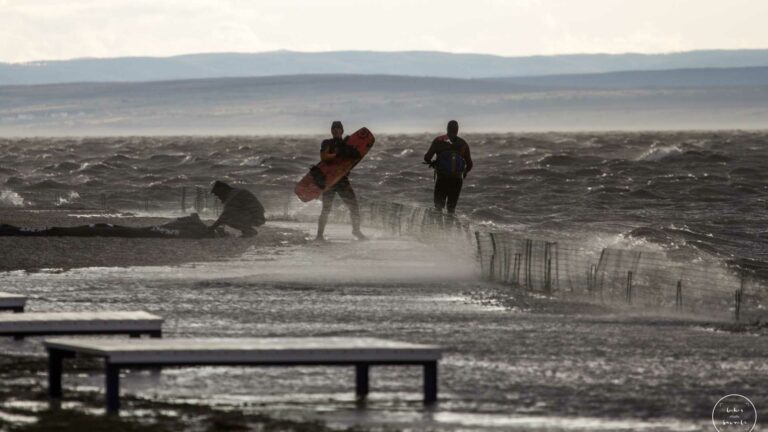
- Hold the kite again low at the edge of the wind window. Not at 12 o'clock.
- Board has no priority for now. And boards can fly far and pose a certain risk.
- On the beach: please take a seat - Again: sit down .
- Now slowly steer the kite down the edge of the wind window into the arms of the person helping you to land. By the way, there are many people who try to catch the kite at the trailing edge in stress. Steer the kite up again. The following applies: Touch kites at the front tube only (foil kites at the tip). Kites nur an der Fronttube anfassen (bei Foil Kites am Tip).
- Landed and secured, stress over for you? Then turn around and help the other kiters. You probably aren't alone at the spot.
- Of course you can also pull the quick release before getting onshore and let the kite hang on to the safety. I assume that other kiters will make their way to you and take or secure your kite.
According to our legal advisor Ms. Rauchwarter (name has not been changed by the editors), I have to mention the following things: Always check the wind forecasts , know your own limits and do not try to prove anything to anyone. And even 10 square meters with 40 knots is no invitation to imitate. Know your level.
Conclusion: Kiting with a lot of pressure in the kite is just fun. The smaller the kites and the stronger the wind, the higher you can jump. However, there are situations when it just gets too much. And then it is important to react correctly. Be pre-occupied with emergency situations and your security system, get to know the spot with certain signs and play it through in your head what options and scope for action there are. Keep calm, do not react hectically and reduce the speed or do not allow speed. And train your thighs, because "pushing the edge" and building pressure is one of the important things in kitesurfing.
Pictures by 'Locker Baumeln', special thanks for that!